Natural health has never been about finding one miracle product that solves every problem. Instead, many practitioners have long believed that different tools serve different purposes and may complement one another as part of a broader wellness philosophy.
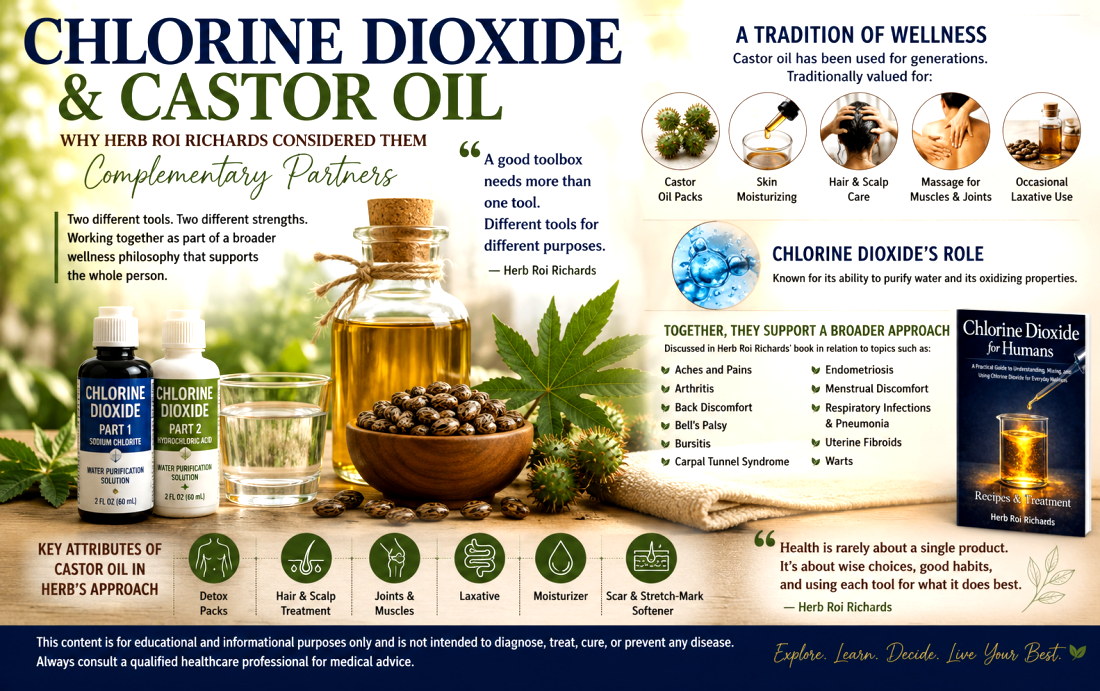
That perspective is central to Herb Roi Richards’ book, Chlorine Dioxide for Humans: Recipes & Treatment. Throughout the book, Richards frequently mentions castor oil alongside chlorine dioxide—not because he viewed them as interchangeable, but because he believed each contributed something different to a person’s overall wellness routine.
In his view, chlorine dioxide and castor oil were teammates rather than competitors.

Different Tools for Different Jobs
Richards often compared health to building a house.
A carpenter does not rely on a single tool to complete every task.
Likewise, Richards believed that no single wellness practice addresses every aspect of the human body. Instead, he encouraged readers to think in terms of complementary approaches that support one another.
Within that framework, chlorine dioxide was discussed primarily in relation to water purification and its oxidative properties, while castor oil was valued for its long history of traditional external uses and general body care.
Although the two were often mentioned in the same chapters, Richards did not describe them as doing the same thing. Rather, he viewed them as supporting different aspects of a broader personal wellness strategy.
A Long Tradition of Castor Oil
Castor oil has been used for generations in homes around the world.
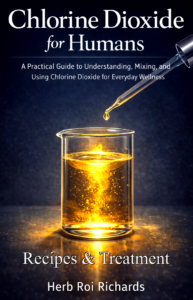
Traditionally, people have incorporated it into personal care routines for purposes such as:
- castor oil packs
- skin moisturizing
- scalp and hair conditioning
- massage
- softening scars and stretch marks
- occasional laxative use when appropriate
- general comfort for muscles and joints
These traditional uses have been passed from one generation to another for decades, helping castor oil maintain its place in many natural wellness traditions.
Why Richards Frequently Mentioned Both
Readers of Chlorine Dioxide for Humans: Recipes & Treatment will quickly notice that castor oil appears repeatedly throughout the book.
Richards discusses it alongside chlorine dioxide in chapters involving subjects such as:
- aches and pains
- arthritis
- back discomfort
- Bell’s palsy
- bursitis
- carpal tunnel syndrome
- endometriosis
- menstrual discomfort
- respiratory infections
- uterine fibroids
- warts
He also highlights castor oil in discussions involving:
- detox packs
- hair and scalp care
- joint and muscle support
- moisturizing dry skin
- scar and stretch-mark softening
These references reflect Richards’ personal wellness philosophy and the organization of his book. They should not be interpreted as established medical treatments for these conditions.
Looking Beyond Individual Symptoms
One of the themes that runs throughout Richards’ writing is the idea that people are more than a collection of isolated symptoms.
Someone experiencing joint discomfort may also struggle with sleep.
Someone recovering from illness may also be dealing with muscle tension, dry skin, stress, or fatigue.
Rather than viewing these as unrelated problems, Richards encouraged readers to support the whole person through multiple healthy habits working together.
His philosophy included attention to hydration, nutrition, movement, sunlight, stress management, rest, and traditional wellness practices—including both chlorine dioxide and castor oil.
A Philosophy of Complementary Support
Perhaps the most interesting aspect of Richards’ work is that he rarely presented natural wellness as an “either-or” decision.
Instead, he consistently favored the idea that different practices may complement one another.
In that sense, chlorine dioxide and castor oil represent more than two individual products.
They illustrate Richards’ broader belief that health often improves through thoughtful combinations of supportive habits rather than dependence on a single solution.
Continuing the Conversation
As interest in complementary health continues to grow, Richards’ work invites readers to think beyond simple answers.
His writings encourage curiosity, careful observation, and personal responsibility while recognizing that many traditional practices remain topics of ongoing scientific discussion.
Whether readers ultimately agree with every conclusion or not, Chlorine Dioxide for Humans: Recipes & Treatment offers an opportunity to explore one practitioner’s integrated approach to natural wellness and the complementary role he believed chlorine dioxide and castor oil could play within that larger philosophy.
How Do You Use Chlorine Dioxide and Castor Oil?
Answer Below
Educational Notice
This article discusses Herb Roi Richards’ published wellness philosophy and summarizes themes from Chlorine Dioxide for Humans: Recipes & Treatment. It is intended for educational and informational purposes only. References to castor oil reflect its traditional uses, and references to chlorine dioxide reflect the author’s perspective. This article should not be interpreted as medical advice or as evidence that these approaches are established treatments for any disease or medical condition. Readers are encouraged to conduct their own research, review the available scientific literature, and consult qualified healthcare professionals when making decisions about their health.