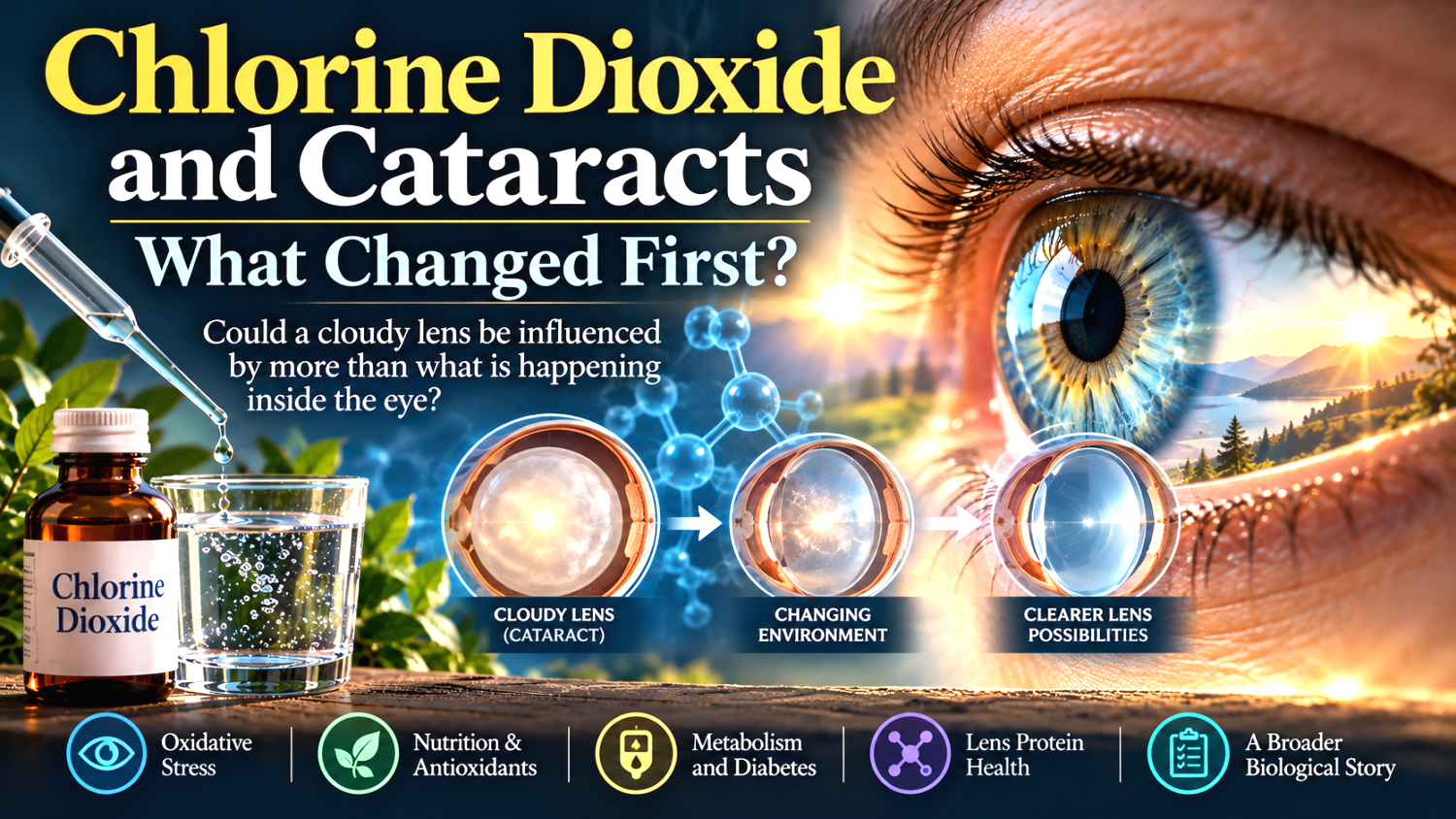
Could a Cloudy Lens Be Influenced by More Than What Is Happening Inside the Eye? At first glance, cataracts and chlorine dioxide seem like an unlikely pair. A cataract develops when the normally transparent lens of the eye becomes cloudy. Chlorine dioxide is best known as an oxidizing antimicrobial used in water treatment and disinfection. Yet Herb Roi Richards included cataracts among the conditions discussed in his field work with chlorine dioxide, and other figures in the chlorine dioxide community have explored very different approaches to eye health.
Long before the current chlorine dioxide movement, some physicians were also experimenting with DMSO and antioxidant compounds in people with cataracts and other eye conditions. Pasted text
Together, these observations raise an interesting question: What if a cataract is influenced by more than what is happening inside the cloudy lens itself?
Cataracts Are More Than a Cloudy Film
A cataract is not a film growing over the outside of the eye. The clouding occurs within the lens. The lens must remain remarkably transparent to properly focus light. Its proteins exist in a highly organized environment that must be maintained for decades. As those proteins become damaged or aggregate, the lens gradually loses transparency.
Age is the greatest risk factor, but cataract development can also be associated with diabetes, smoking, ultraviolet exposure, certain medications, trauma and oxidative damage. That makes cataracts more than a mechanical problem. They also involve the biological environment of the lens.
Oxidative Stress and the Lens
The lens has natural systems that protect its proteins from oxidative damage. Antioxidant defenses, including glutathione, play an important role in maintaining normal lens chemistry. As people age, the balance between oxidative stress and the lens’s ability to protect and maintain its proteins can deteriorate.
This does not mean that taking antioxidants will reverse an established cataract. It does, however, help explain why so much cataract research and natural eye-health literature focuses on oxidative stress, nutrition and antioxidant protection.
The collected material surrounding cataracts includes lutein and zeaxanthin, vitamin C, bilberry, curcumin, saffron, quercetin, resveratrol and other nutritional compounds investigated for various aspects of eye health. Pasted text Pasted text
These substances do not all have equal evidence behind them, and some of the research is preclinical. But collectively, they illustrate an important concept: Supporting the environment in which the lens exists may be as interesting as focusing exclusively on the cataract itself.
Diabetes Shows How an Upstream Problem Can Reach the Eye
Diabetes provides a particularly useful example.
Elevated glucose can alter the chemistry and metabolism of the lens. Changes within the lens can increase osmotic and oxidative stress and contribute to cataract formation.
The pathway might be simplified as:
POOR GLUCOSE CONTROL
↓
ALTERED LENS METABOLISM
↓
OXIDATIVE AND OSMOTIC STRESS
↓
PROTEIN DAMAGE
↓
LOSS OF LENS TRANSPARENCY
↓
CATARACT
Not every cataract is caused by diabetes. The importance of this example is that a problem occurring elsewhere in the body can influence what eventually becomes visible inside the eye.
This raises a broader question: Could improving an upstream biological condition sometimes influence what happens downstream in the lens?

An Earlier DMSO Connection
The historical material surrounding DMSO adds another dimension. According to a report presented to the American College for Advancement in Medicine (ACAM) in May 1980, an ophthalmologist described using DMSO in approximately 200 patients with several eye disorders, including macular degeneration, macular edema and traumatic uveitis. For cataracts, the physician reportedly used topical DMSO. Other physicians described formulations involving DMSO and superoxide dismutase, or SOD. Pasted text
These reports do not establish DMSO as a clinically proven cataract treatment. They are nevertheless historically interesting because they reflect an attempt to influence eye chemistry rather than viewing cataracts solely as an irreversible mechanical change.
DMSO has long attracted interest because of its ability to penetrate biological membranes and enhance the delivery of some substances. SOD, meanwhile, is an antioxidant enzyme involved in controlling reactive oxygen species.
Once again, several familiar themes appear:
- oxidative stress
- antioxidant defenses
- biological delivery
- lens chemistry
Herb Roi Richards’ Approach to Cataracts
Herb Roi Richards approached cataracts somewhat differently.
His field material describes an oral chlorine dioxide regimen combined with indirect vapor exposure near the face and supportive measures that included magnesium chloride, antioxidant-rich foods and other companion products. Pasted text
The significance of Herb’s approach is not simply what was being used. It is the way he apparently viewed the problem.
Rather than treating the cataract exclusively as something that needed to be acted upon directly, his approach included systemic support.
That fits a recurring question surrounding many of Herb’s observations:
Could the apparent destination of an improvement be different from its biological starting point?

Other Chlorine Dioxide Practitioners Took a Different Approach
Andreas Kalcker described an ophthalmic approach called “Protocol O,” involving a highly diluted CDS preparation with saline and optional DMSO. His material describes using the preparation for ocular and nasal conditions. Pasted text
Jim Humble also described a highly diluted activated MMS preparation intended as eye drops. Pasted text
These preparation instructions are not reproduced here. Products applied directly to the eye require careful control of concentration, pH, sterility, osmolarity and tissue compatibility. From an investigative standpoint, however, the differences are noteworthy.
Herb emphasized a largely systemic approach. Kalcker and Humble described direct ophthalmic approaches. Earlier DMSO practitioners experimented with local DMSO and antioxidant-related approaches.
Different methods were being used in pursuit of a similar outcome.
That raises another useful question: What, if anything, did these approaches have in common biologically?
Could the Biological Environment Be the Missing Piece?
Suppose that some reported improvements were genuine and objectively measurable. Several possibilities could then be investigated.
- Oxidative stress might have changed.
- Antioxidant defenses might have changed.
- Glucose regulation might have improved.
- Inflammatory conditions might have changed.
- Lens metabolism might have changed.
Another intervention being used simultaneously might have produced the improvement. Or the person’s vision may have improved without the cataract itself substantially changing. That last distinction is especially important.
“I can see better” and “my cataract reversed” are not necessarily the same observation.
Visual acuity can change for multiple reasons. Demonstrating cataract reversal would require documenting an actual change in lens opacity.
N-Acetylcarnosine and the Search for Nonsurgical Approaches
The collected material also describes a 2002 study involving 49 people with cataracts. Twenty-six participants received eye drops containing 1% N-acetylcarnosine, while others received placebo drops or no drops. The reported results included improvements in visual acuity and glare sensitivity among treated participants. Pasted text
N-acetylcarnosine has not replaced cataract surgery as the established treatment for vision-limiting cataracts, and its effectiveness remains debated. Its importance to this discussion is broader.
Researchers have explored whether the biochemical environment of the lens can be influenced rather than assuming that nothing can be done until the lens is surgically replaced.
Nutrition and Cataract Research
Nutrition provides another example of this approach.
The collected material highlights colorful fruits and vegetables, including citrus fruits, tomatoes, carrots and dark leafy greens, in connection with cataract prevention and eye health. Pasted text
Lutein, zeaxanthin, zinc, selenium, riboflavin, taurine and quercetin also appear among nutrients discussed for supporting the eyes. Pasted text Vitamin C has likewise been studied in relation to cataract risk. Pasted text
Preventing cataracts, slowing their progression and reversing an established cataract are very different claims. Nevertheless, this research reinforces a central point:
The lens is living tissue influenced by the biological environment surrounding it.
The Chlorine Dioxide Paradox
Chlorine dioxide adds an unusual complication to the discussion. Chlorine dioxide is an oxidizer. Oxidative damage is involved in cataract formation.
At first glance, those facts seem contradictory. But biological oxidation is not a simple good-or-bad switch. Effects depend upon concentration, location, duration, molecular targets and the surrounding biological environment.
Chlorine dioxide also has selective reaction chemistry. It does not react equally with every biological molecule it encounters. What remains unknown is whether those characteristics translate into a beneficial effect on cataract biology.
The unanswered pathway might look something like this:
CHLORINE DIOXIDE
↓
UNKNOWN INTERMEDIATE EFFECT
↓
CHANGE IN THE BIOLOGICAL ENVIRONMENT
↓
LENS CHEMISTRY / OXIDATIVE BALANCE / PROTEIN STABILITY
↓
POSSIBLE CHANGE IN VISION OR CATARACT
The missing steps are precisely what need investigation.
Maybe the Eye Isn’t the Beginning of the Story
A cataract is visible in the eye, but the biological story leading to it may involve much more than the eye.
Glucose metabolism can matter. Nutrition can matter. Oxidative stress can matter. Antioxidant defenses can matter. Age, medications, ultraviolet exposure and other factors can matter.
This creates a useful framework for investigating reports involving chlorine dioxide without requiring the assumption that chlorine dioxide somehow directly “dissolves” a cataract.
Perhaps something upstream changed. Perhaps something local changed. Perhaps several things changed simultaneously. Perhaps chlorine dioxide had nothing to do with the improvement.
The way to distinguish among those possibilities is documentation.
What Changed First?
When someone reports that chlorine dioxide improved or reversed a cataract, the most useful next step is not simply collecting another testimonial. It is determining what actually changed.
- Was the cataract professionally diagnosed beforehand?
- What was its grade?
- What was the person’s visual acuity?
- Was glare sensitivity measured?
- Was the lens photographed?
- Was the person diabetic?
- What was happening with glucose control?
- What medications and supplements were being used?
- Were nutritional changes made?
- Was DMSO involved?
- Was anything applied directly to the eye?
- When did the improvement begin?
- Did a subsequent ophthalmic examination confirm a change in lens opacity?
- Did the improvement persist?
Those questions turn an interesting story into an investigable observation.
From Testimonials to Evidence
The chlorine dioxide community has accumulated many personal reports over the years. The next step could be considerably more useful than simply collecting more stories.
Imagine documenting a series of cataract cases with:
- professional diagnosis before intervention
- lens photographs
- cataract grading
- visual acuity
- glare testing
- relevant metabolic measurements
- complete documentation of interventions
and appropriate follow-up measurements.
Several outcomes would be informative.
- If people feel their vision improved but the cataract remains unchanged, that tells us something.
- If cataract progression appears to slow, that tells us something different.
- If objective lens opacity decreases, that becomes especially interesting.
- And if another measurable biological change consistently occurs before the eye changes, it may reveal an upstream pathway worth studying.
The Observation May Be Right Even When the Explanation Is Incomplete
Herb Roi Richards worked extensively from field observations. People told him what happened. He compared their experiences, looked for recurring patterns and developed theories from what he observed. Some of those theories may ultimately prove correct. Others may not. But an incomplete explanation does not automatically make an observation worthless.
People sometimes observe the end of a biological chain before science understands its beginning or middle. That is why recurring reports are best treated neither as proof nor as something to dismiss automatically. They are opportunities to ask better questions.
Cataracts May Offer Another Window Into Chlorine Dioxide
Modern cataract surgery is highly effective and remains the established treatment when cataracts significantly interfere with vision. That does not mean the biology leading to cataract formation has been completely explored.
If cataract development involves oxidative stress, metabolism, nutrition, protein maintenance and other potentially modifiable biological processes, there is good reason to continue investigating those pathways. And if people using chlorine dioxide continue reporting unexpected changes in cataracts or vision, those reports can be documented much more carefully than they have been in the past.
- Measure the lens.
- Measure the vision.
- Document the intervention.
- Record the other variables.
- Follow the timeline.
And ask the question that continues to surface throughout the investigation of chlorine dioxide:
- What Changed First?
The most interesting discovery may not ultimately be that chlorine dioxide somehow “dissolves” cataracts. It may be that changing something elsewhere alters the biological environment in which the lens is struggling to remain clear.
If so, the cloudy lens may simply be the place where the change finally becomes visible.
Informational Notice: This article examines historical reports, practitioner observations and research questions concerning cataracts and chlorine dioxide. It does not establish chlorine dioxide, DMSO or other substances discussed here as treatments for cataracts. Direct application of non-ophthalmic preparations to the eye can cause injury. Cataracts and changes in vision should be evaluated by a qualified eye-care professional.