In January 2010, American inventor Howard M. Alliger began pursuing patent protection for an approach to treating acute and chronic sinusitis using chlorine dioxide. The invention addressed a persistent challenge in respiratory medicine: inflammation and infection involving the nasal passages and sinus cavities, particularly when symptoms continue despite conventional treatment.
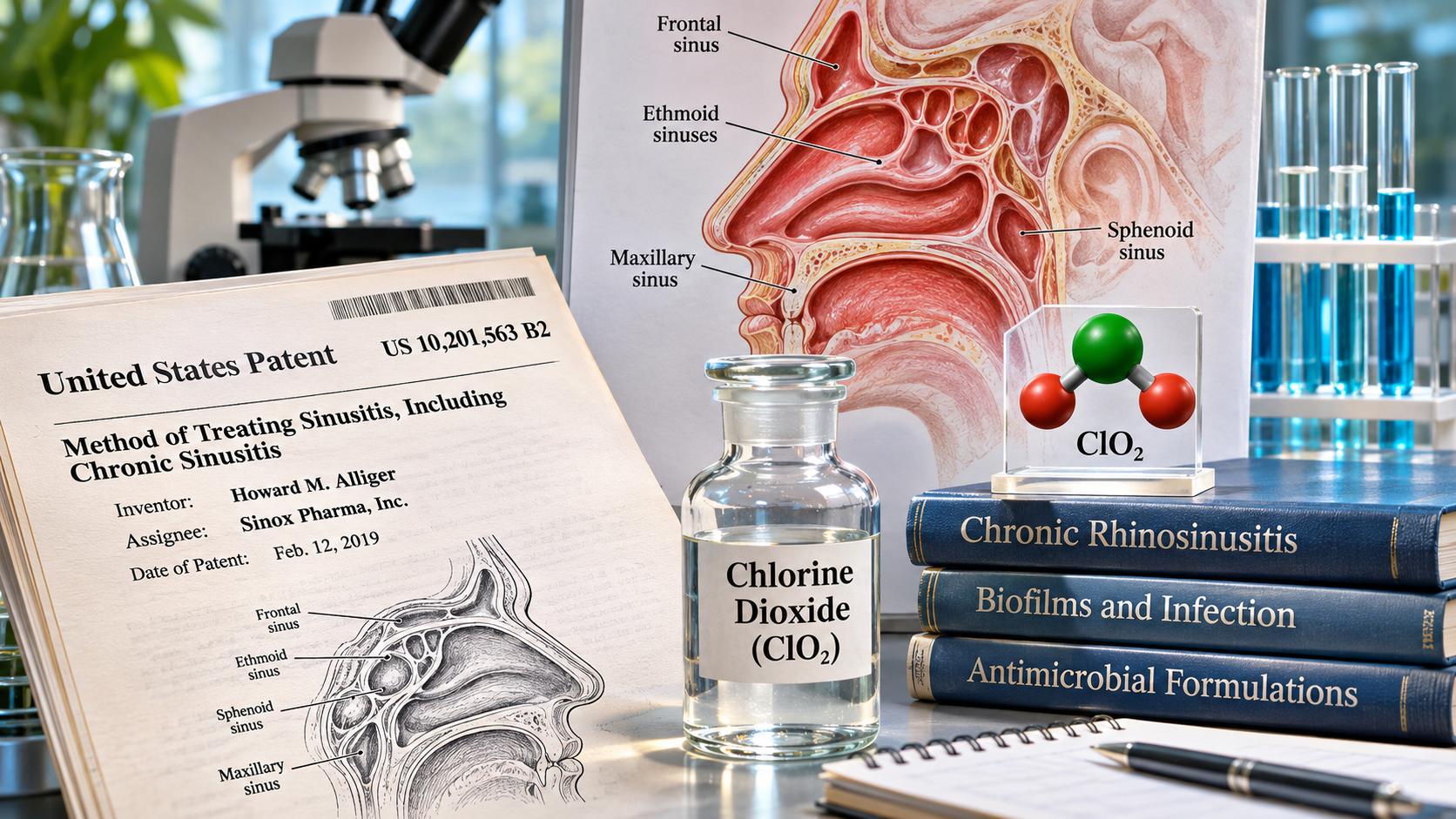
Alliger proposed that chlorine dioxide’s antimicrobial chemistry, combined with its potential interactions with mucus, microbial biofilms, and inflammatory processes, might offer another way to investigate these conditions. The invention eventually became the subject of international patent filings and a United States patent granted in February 2019.
The research history also extends beyond the patent itself. Subsequent scientific literature identifies a commercial chlorine dioxide nasal formulation associated with Sinox Pharma, the company named in the patent records.
These documents provide an opportunity to examine the invention’s origins, the biological reasoning behind it, the experimental observations described by the inventor, and what can be established about its subsequent development.
The Patent That Started the Investigation
The principal document is US10201563B2, Method of Treating Sinusitis, Including Chronic Sinusitis. The patent identifies Howard M. Alliger as inventor and Sinox Pharma, Inc. as assignee. Its priority date is January 19, 2010. The corresponding United States application was filed November 25, 2015, and the patent was granted February 12, 2019.
The invention had already entered the international patent system years earlier through WO2011090932A2, published July 28, 2011. Other records include the earlier American application US20130108714A1 and Canadian patent CA2787512C.
These documents belong to the same underlying invention family. They represent its development through different patent offices, rather than independent scientific discoveries. The central invention concerns exposing affected sinus and surrounding tissues to chlorine dioxide-containing compositions, with particular attention to chronic sinusitis.
Why Chronic Sinusitis Was an Interesting Research Target
Chronic rhinosinusitis is a complex inflammatory condition involving the nose and paranasal sinuses. Symptoms may include nasal obstruction, mucus accumulation, facial pressure, and impaired sense of smell.
Although microbial infections can contribute to some cases, chronic rhinosinusitis is not simply a persistent bacterial infection. Its development may involve impaired mucociliary clearance, allergies, inflammatory responses, nasal polyps, and changes in the microbial communities associated with sinus tissues.
Biofilms have also received attention in chronic sinusitis research. A biofilm is a structured community of microorganisms embedded within a protective extracellular matrix. Biofilm-associated organisms can behave differently from free-floating microorganisms, potentially complicating treatment and contributing to persistent disease.
Alliger’s patent specifically discusses biofilms, fungal involvement, mucus accumulation, and inflammatory processes.
The inventor’s underlying question was whether a chemical agent already known for antimicrobial activity in industrial and environmental settings might have useful properties when applied to tissues associated with chronic sinusitis.
The Inventor’s Background in Chlorine Dioxide Chemistry
The sinusitis patent was not Alliger’s first involvement with chlorine dioxide. An earlier invention, US4084747A, Germ Killing Composition and Method, was granted in April 1978. Another patent, US6039934A, Use of Xanthan Gum for Gelling ClO2 and Related Species, was granted in March 2000.
These earlier documents establish that Alliger had pursued chlorine dioxide-related inventions for decades before the sinusitis patent.
The 2000 patent addressed formulation technology, particularly the use of xanthan gum to produce gelled compositions involving chlorine dioxide and related chemical species. This background helps explain why the later sinusitis invention devoted substantial attention to formulation chemistry, stability, and delivery.
The inventor was not simply proposing that an existing industrial disinfectant be transferred unchanged into a medical setting. The patent describes attempts to adapt chlorine dioxide-containing compositions to the particular challenges of biological tissue exposure.
The Proposed Role of Chlorine Dioxide
The sinusitis patent describes several possible mechanisms through which chlorine dioxide might affect the condition.
The first is antimicrobial activity.
Chlorine dioxide is an oxidizing agent capable of reacting with susceptible biological molecules. Its established use in water treatment and industrial disinfection provided a starting point for the inventor’s reasoning.
The second proposed mechanism involves mucus and biofilms.
Alliger suggested that chlorine dioxide’s chemical characteristics might allow it to interact with microbial communities protected by mucus or biofilm structures.
The third proposed mechanism involves inflammatory mediators.
The patent discusses cytokines, eosinophils, and other components of inflammatory responses, proposing that chlorine dioxide might alter some of the chemical processes contributing to sinus discomfort.
These ideas are not equivalent. Antimicrobial activity can be investigated through laboratory measurements of microbial survival. Biofilm disruption requires experiments examining organized microbial communities and their protective matrices. Effects on inflammation require measurements involving immune cells, inflammatory mediators, tissue responses, or clinical symptoms.
The patent brings these possibilities together as part of the inventor’s proposed explanation, but they require different kinds of experimental evidence.
Biofilms: One of the More Interesting Hypotheses
The patent’s discussion of biofilms is particularly relevant to the history of chronic sinusitis research. Alliger noted that chlorine dioxide had long been used in industrial settings to address microbial films in water-handling systems. He proposed that similar chemical properties might be relevant to microbial biofilms associated with nasal passages.
This is an example of transferring a research question from one field into another.
Industrial biofilms and biofilms associated with living tissues share certain structural characteristics, but they exist under very different conditions.
A chemical capable of disrupting biofilms in pipes or water systems does not necessarily have the same behavior when exposed to mucus, proteins, living epithelial cells, and the immune environment of human tissue.
The patent’s significance is that it identifies biofilm disruption as a potential research direction.
Determining whether a particular chlorine dioxide formulation could selectively affect sinus-associated biofilms would require experiments involving relevant microbial species, tissue models, and clinical outcomes.
What the Patent Reports About Human Observations
One of the most revealing portions of the patent appears in its discussion of how the inventor developed the proposed treatment.
Alliger describes personal experimentation involving chlorine dioxide-containing mouthwash formulations. According to the patent, observations during gargling led him to investigate effects involving the throat, nasal passages, and sinus drainage.
The inventor reports experiencing changes in nasal congestion and mucus clearance, which prompted further exploration of localized applications.
The patent also describes observations of temporary irritation and the inventor’s efforts to identify formulations he considered more tolerable.
These passages are useful historical evidence because they describe the apparent origin of the invention. However, the reported observations are presented as the inventor’s experience and development narrative. They are not accompanied by a controlled clinical dataset establishing treatment efficacy.
The document does not provide a clearly defined clinical population, randomized comparison groups, standardized symptom assessments, or independently adjudicated outcomes for the claims of sinusitis improvement.
This distinction does not erase the observations. It identifies their evidentiary status. They are inventor-reported findings that may have helped generate a hypothesis, rather than independently verified clinical results.
What the Patent Actually Claims
The granted American patent contains 28 claims. Its principal claim concerns chlorine dioxide-containing compositions proposed for treating, inhibiting, or reducing the likelihood of sinusitis.
The dependent claims describe different formulations and routes of localized exposure. These include applications involving nasal membranes, the upper mouth, gargling, aerosols, and other delivery concepts. The invention therefore extends beyond a conventional mouthwash. It concerns a proposed method of bringing chlorine dioxide-containing compositions into contact with tissues associated with the upper respiratory system.
The breadth of the claims reflects the inventor’s attempt to protect different implementations of the underlying idea.
Patent claims, however, describe the scope of an invention for which legal protection is sought or granted. They are not equivalent to the results of clinical trials.
International Patent Development
The invention’s patent history provides another useful perspective. The earliest priority filing dates to January 2010. An international application followed in January 2011, with publication in July of that year. An American application was published in 2013, while a later continuation application was filed in 2015. The resulting American patent was granted in February 2019.
The international application is recorded as ceased, and the earlier American application as abandoned. The later United States patent is recorded as active in the patent database consulted.
The presence of both abandoned applications and a granted continuation is not unusual in patent prosecution. It illustrates how an inventor may revise or continue claims over time while pursuing protection for the underlying technology. The Canadian patent record provides additional evidence that protection was sought beyond the United States.
The Commercial Development Connection
An especially interesting development appears in a 2020 scientific article discussing acidified sodium chlorite-derived chlorine dioxide preparations for nasal and oral applications.
The article is titled: Acidified Sodium Chlorite Solution: A Potential Prophylaxis to Mitigate Impact of Multiple Exposures to COVID-19 in Frontline Health-Care Providers, published in Hospital Practice, the paper discusses the possibility of investigating chlorine dioxide-containing preparations as an approach to reducing exposure-related infection risks.
Among the products mentioned is Snoot, identified as a formulation associated with Sinox Pharma, Inc. This is a noteworthy connection. The patent record identifies Sinox Pharma as the company associated with Alliger’s sinusitis invention. The later publication identifies a commercially available nasal preparation associated with the same company.
The evidence therefore supports a connection between the patent development program and a product that was discussed in subsequent scientific literature. It does not, by itself, establish the product’s regulatory classification, current commercial availability, or clinical effectiveness.
What About Human Tolerability Data?
The 2020 article refers to tolerability information supplied by Sinox Pharma. The authors describe company-held data from 2017 concerning nasal exposure to a chlorine dioxide-containing formulation.
The distinction is important: these data were described as being on file with the company, rather than published as a complete, independently accessible clinical study.
The article also acknowledged the absence of published human intranasal findings at that time.
Consequently, the publication establishes that tolerability observations were reportedly collected or held by the company, but it does not provide enough information to independently evaluate their methodology, sample size, or results.
Obtaining the original study documentation would be a useful next step for researchers investigating the product’s development history.
A Related Clinical Research Direction: Hypochlorous Acid
A separate clinical trial published in 2016 investigated low-concentration hypochlorous acid nasal irrigation in patients with chronic rhinosinusitis. The study enrolled 43 adults and compared hypochlorous acid irrigation with saline over eight weeks. The investigators reported improvements in some symptom measurements among participants receiving hypochlorous acid.
Low-Concentration Hypochlorous Acid Nasal Irrigation for Chronic Sinonasal Symptoms: A Prospective Randomized Placebo-Controlled Study. This study is relevant to the broader history of oxidizing antimicrobial formulations investigated for sinonasal conditions. However, hypochlorous acid and chlorine dioxide are chemically distinct substances.
The trial therefore cannot be used as direct clinical corroboration of Alliger’s chlorine dioxide invention. Its relevance is that it documents independent clinical interest in another oxidizing formulation for chronic sinonasal symptoms.
That comparison may be useful to researchers examining the wider development of topical antimicrobial approaches.
What Happened After the Patent?
The available records establish several developments. Alliger’s chlorine dioxide-related patent history extends back to the 1970s. The sinusitis invention entered the patent system in 2010. International and American applications followed.
A United States patent was granted in 2019. A 2020 scientific publication identified a Sinox Pharma nasal formulation and referred to company-held tolerability information.
These findings demonstrate that the invention progressed beyond an isolated patent filing into at least some form of product development and subsequent scientific discussion.
What remains less clear is whether Sinox Pharma conducted formal controlled clinical trials specifically evaluating chlorine dioxide for chronic sinusitis.
The sources examined for this article did not establish the existence of a published randomized trial of the patented chlorine dioxide formulation. Nor did they establish whether independent researchers reproduced the inventor’s reported observations. Those questions remain appropriate subjects for further investigation.
Questions Worth Pursuing
Several lines of inquiry could help complete the historical record.
The first concerns Sinox Pharma’s unpublished 2017 tolerability information. Access to the original report could clarify its design, population, observations, and conclusions.
The second concerns product development. Additional records might establish whether the commercial formulation underwent formal performance testing, regulatory review, or clinical investigation.
The third concerns biofilms. Laboratory research using sinus-associated microbial biofilms could help determine whether the inventor’s proposed mechanism was subsequently investigated.
The fourth concerns inflammation. The patent’s discussion of cytokines and eosinophils raises mechanistic questions that would require direct experimental measurements.
Finally, patent citation records may identify later inventions that built upon or distinguished Alliger’s work. Together, these questions offer a path toward understanding how far the original invention progressed beyond its patent disclosures.
Conclusion
Howard M. Alliger’s sinusitis patent represents a documented American effort to investigate chlorine dioxide-containing formulations for localized upper-respiratory applications.
The invention emerged from decades of the inventor’s earlier work involving chlorine dioxide chemistry and formulation technology. Its central hypothesis concerned whether chlorine dioxide’s oxidative properties could be adapted to conditions involving sinus inflammation, microbial activity, mucus accumulation, and biofilms.
The patent describes inventor-reported observations and proposes several biological mechanisms, although the document does not provide controlled clinical evidence establishing the proposed treatment outcomes.
The subsequent appearance of a Sinox Pharma nasal formulation in a 2020 scientific publication adds an important development to the historical record.
It shows that the research direction extended beyond the original patent application and into a commercially identified formulation discussed in scientific literature.
At the same time, the available documents leave several questions unresolved, particularly regarding independently published human studies, biofilm experiments, and the clinical development history of the patented approach.
For researchers investigating chronic rhinosinusitis, antimicrobial chemistry, biofilms, or the history of pharmaceutical inventions, the patent and its associated records provide a useful collection of primary documents and leads for further investigation.
Primary Sources and Further Reading
- United States patent, granted 2019
US10201563B2: Method of Treating Sinusitis, Including Chronic Sinusitis
Inventor: Howard M. Alliger. Assignee: Sinox Pharma, Inc.
- International patent application, published 2011
WO2011090932A2: A Method of Treating Sinusitis, Including Chronic Sinusitis
Priority date: January 19, 2010.
- United States patent application, published 2013
US20130108714A1: Method of Treating Sinusitis, Including Chronic Sinusitis
Earlier American application in the same invention family.
- Earlier chlorine dioxide invention, granted 1978
US4084747A: Germ Killing Composition and Method
Inventor: Howard M. Alliger.
- Formulation patent, granted 2000
US6039934A: Use of Xanthan Gum for Gelling ClO2 and Related Species
Inventor: Howard M. Alliger.
- Scientific publication, 2020
Hospital Practice. Includes discussion of a Sinox Pharma formulation and company-held tolerability information.
- Related clinical trial, 2016
A study of hypochlorous acid, a chemically distinct oxidizing agent, included for comparative research context.